2026-05-29
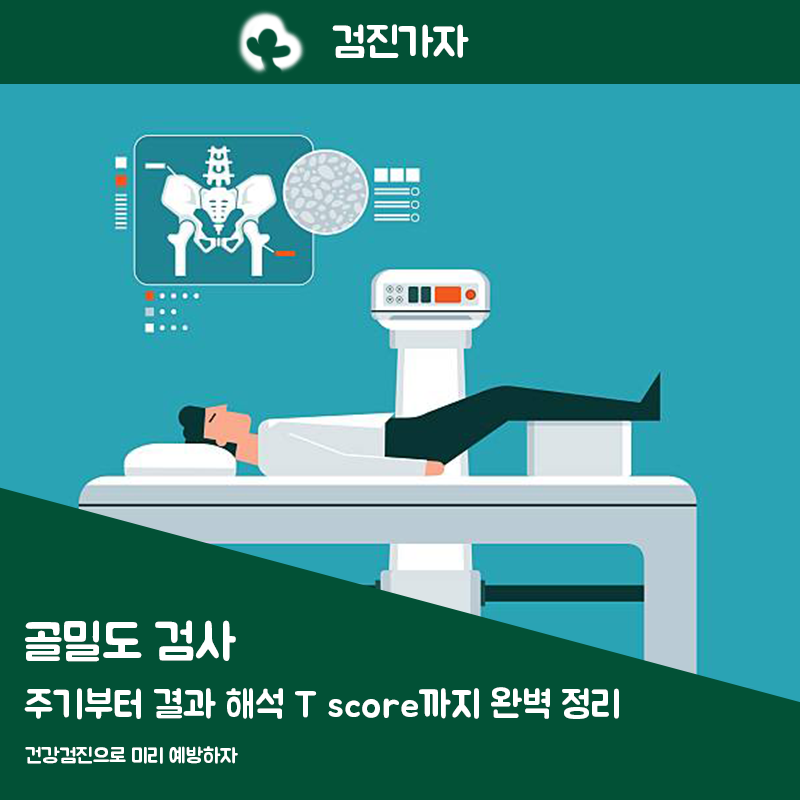
A Complete Guide to Bone Density Tests: From Frequency to T-Score Interpretation
Learn all about bone density tests, including who should get tested, what to check before the test, how it's performed, and how to interpret your T-score results. Understand the importance of regular screening for bone health.
Hello,
This is Geomjingaja.
I hope you enjoyed the cherry blossoms this year.
If you felt your bones ache whenever it rained,
how about getting a bone density test this time?
Bones are the fundamental structure
that supports our body.
However, as we age,
if there are abnormalities in bone metabolism
or calcium imbalance, bone mass and
density can rapidly decrease.

The problem is that this process
often progresses without pain.
This can lead to osteoporosis, where bones can break
even from minor impacts.
Let's learn more about bone density testing,
a measure of bone health.
Who should get a bone density test?
Prevention is paramount for osteoporosis.
Regular testing is essential, especially if you have
the following risk factors:
Women aged 65 or older and
men aged 70 or older
Postmenopausal women or women who have undergone
early menopause due to ovarian removal surgery
Individuals with fracture risk factors such as
low body weight, history of frequent fractures, or family history
Individuals currently receiving
osteoporosis medication therapy
Be sure to check these before the test!
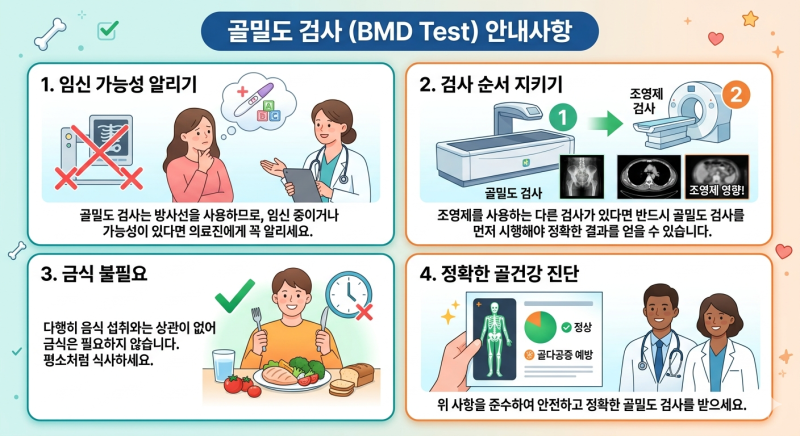
Bone density tests use radiation, so if you are
pregnant or suspect you might be,
you must inform the medical staff in advance.
Also, if you have other tests
that use contrast agents,
the bone density test must be performed first
to obtain accurate results.
Fortunately, it is not affected by food intake,
so fasting is not required.
If there are metal accessories, zippers, or buttons
on the examination area (waist or thigh),
they can be considered foreign objects and affect the results.
It's best to remove them or change into comfortable examination attire.
How is the test performed?
The test is performed by lying flat on the examination table,
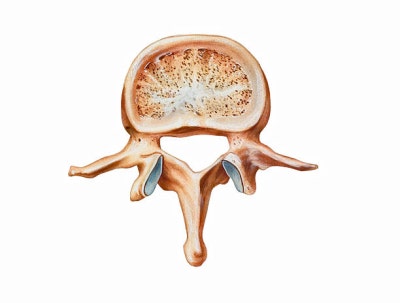
and measurements are primarily taken of the lumbar spine
and femur (hip joint), which are common fracture sites
and have small measurement errors.
Lumbar Spine Test
To straighten the back,
the legs are placed on a support
for measurement.
Hip Joint Test
The ankle is rotated inward
and fixed to the device
for precise measurement.
Whole Body Scan
If necessary, the whole body's
fat mass and bone mass are checked
to also assess for sarcopenia.
How do I read the 'T-score' on my results?
Test results are usually
expressed as a T-score.
This is a comparison to the average bone density
of a young, healthy adult.
-1.0 or higher: Normal
Between -1.0 and -2.5: Osteopenia (caution stage)
-2.5 or lower: Osteoporosis (requires active treatment)
-2.5 or lower with accompanying fracture: Severe osteoporosis
Don't worry about radiation exposure!
Many people worry about radiation exposure,
but the amount of radiation generated during a bone density test
is very low, about 1/10 of a standard chest X-ray.
This is about 1/300 of the natural radiation
received in a year from daily life,
and less than taking a single airplane flight,
so you can undergo the test with peace of mind.
Bone density tests are usually
recommended as an annual regular check-up.
Once bones become weak,
it takes a lot of effort
to recover them.
Take time once a year
to check the health of your bones,
the pillars of your body.
▼ For comprehensive health check-ups including osteoporosis, visit KMI Gwangju ▼
Efficient Booking
For those of us who don't have time to be on the phone,
complete your reservation in just 1 minute via KakaoTalk!
▼ If you need to inquire about KMI Gwangju reservations ▼
(Tel: 1600-2137)

#BoneDensityTest #Osteoporosis #BoneHealth
#Osteopenia #Geomjingaja #HealthCheckup
#FracturePrevention #PostmenopausalHealth #ElderlyHealth
#Tscore #OsteoporosisTest #Calcium #VitaminD #BoneNutrition
Frequently Asked Questions
Who should get a bone density test?
It is recommended for women aged 65 and older, and men aged 70 and older. Additionally, postmenopausal women, women who experienced early menopause due to ovarian removal surgery, and individuals with risk factors for fractures such as low body weight or a family history, also require regular examinations.
Do I need to fast before a bone density test?
No, fasting is not necessary. The test can be performed regardless of food intake. However, if you have other tests that use contrast agents, the bone density test must be performed first for accurate results, and you should inform the medical staff if there is a possibility of pregnancy.
How do I interpret the T-score from a bone density test?
A T-score of -1.0 or higher is considered normal. A score between -1.0 and -2.5 indicates osteopenia, requiring attention, and a score of -2.5 or lower is diagnosed as osteoporosis, necessitating active treatment. If a fracture accompanies a T-score of -2.5 or lower, it is classified as severe osteoporosis.
Is radiation exposure during a bone density test safe?
Yes, it is at a very safe level. The amount of radiation generated during a bone density test is about one-tenth of a general chest X-ray and only about 1/300th of the natural radiation received in daily life over a year. It is less than the amount received from a single airplane flight, so you can rest assured.
How often should I get a bone density test?
It is generally recommended to have a regular check-up once a year. Once bones weaken, it takes a lot of effort to recover, so it is advisable to check the health of your bones, which are the pillars of your body, once a year to prevent osteoporosis.