2026-09-15
I Drank Water the Night Before My Health Checkup: Can I Still Get an Endoscopy? (Honest Hospital Review)
Discover whether an upper endoscopy can still be performed after accidentally drinking water the night before, based on timing, volume, and medical advice.
Hello,
This is Checkup Gaja.
I recently went for my annual
routine health checkup,
and I had an absolute panic the night before.
I’m sharing my story for anyone else
who might find themselves in the same panicked situation.
I was clearly instructed to fast starting from 8:00 PM
the night before my appointment.
However, around 11:00 PM, I felt so thirsty
that before I even realized what I was doing,
I filled up an entire cup of water and gulped it down...
(Sigh... so disappointed in myself...)
Right after swallowing it,
I gasped: "Wait, I'm fasting!"
Since I had an upper endoscopy scheduled,
all sorts of thoughts rushed through my mind:
'Do I have to cancel today\'s procedure?'
'I even took a day off from work, what should I do?'
To get straight to the point,
it depends on the amount of water and the timing.
Here is what the nurse explained to me
after I arrived early at the clinic
and honestly confessed what happened.
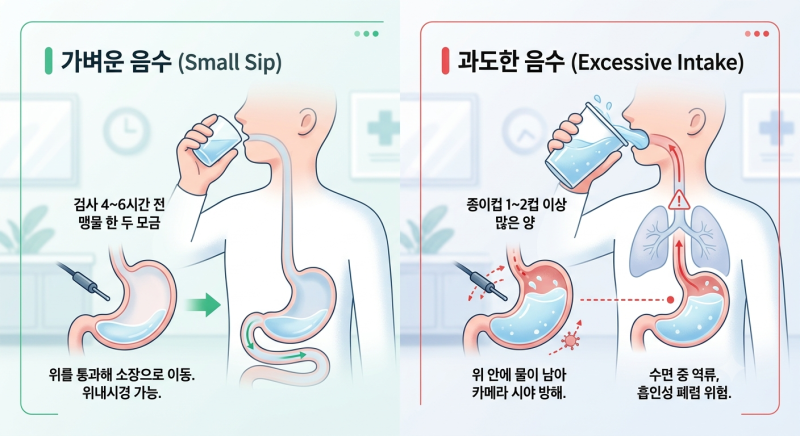
Just a sip or two of plain water
(4 to 6 hours before the examination)
A small sip of plain water usually empties from the stomach
into the small intestine after a certain period,
meaning you can often still proceed with the upper endoscopy.
Drinking 1 to 2 paper cups or more
(a large amount)
If water remains in the stomach,
it can obstruct the view of the endoscope camera.
More critically, during sedation (sleep endoscopy),
it can cause reflux and enter the airway,
posing a serious risk of aspiration pneumonia.
In such cases, your appointment might be pushed back,
or the procedure may need to be canceled for the day.
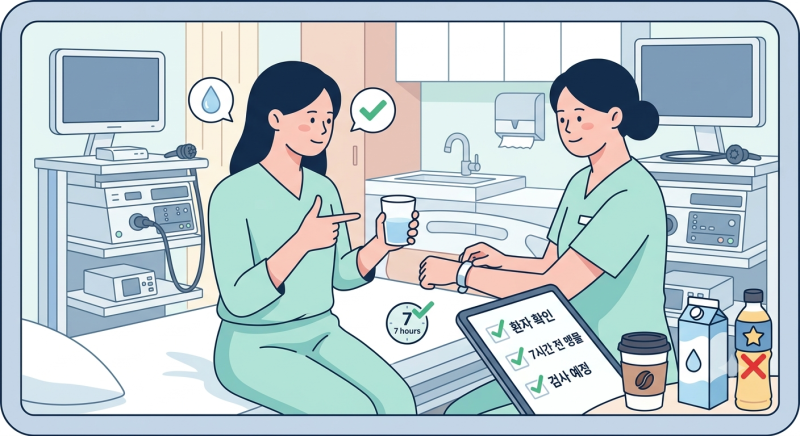
If you drank coffee, milk, sports drinks,
or colored beverages
Any beverage other than plain water can stain the stomach lining
or stimulate gastric secretions.
Even in tiny amounts, it prevents clear visualization,
making cancellation almost certain.
Fortunately for me, it was just plain water,
and more than 7 hours had passed between the drink and my exam.
After the nurse evaluated my situation,
I was cleared to proceed as scheduled.
If you mistakenly drank water the night before your checkup,
please don't panic too much.
When you arrive at the clinic to fill out your medical questionnaire,
be completely honest with the nurse or doctor
about exactly when and how much you drank!
Hiding it can put your safety at risk.
I hope everyone follows the fasting rules properly
and completes their health checkup safely!
Frequently Asked Questions
Can I still get an upper endoscopy if I drank water the night before my health checkup?
It depends on the amount of water and the timing. If you only had a small sip or two of plain water 4 to 6 hours before the test, the water will likely have passed into the small intestine, allowing the procedure to proceed. However, if you drank a large volume or drank it right before the test, the examination may be delayed or canceled.
What problems can occur during an endoscopy if I drink too much water?
It can obscure the endoscopic view and increase the risk of aspiration pneumonia due to reflux. If more than 1 or 2 cups of water remain in the stomach, observation is obstructed, and during sedated endoscopy, fluid could reflux into your airway, which may lead to the procedure being postponed or canceled.
What happens if I drank coffee, milk, or sports drinks instead of water?
The endoscopy will very likely be canceled. Colored or opaque drinks like coffee, milk, and sports drinks can coat the gastric walls or trigger gastric juices, making precise mucosal examination impossible even in small amounts.
What should I do upon arriving at the clinic if I accidentally drank water?
You must inform the medical staff of the exact time and amount of water consumed immediately upon arrival. Sharing this honestly when completing your pre-examination questionnaire allows the doctors to prevent reflux complications and safely evaluate whether you can undergo the procedure.