2026-07-01
Honest Review of the National Health Screening Cervical Cancer Test: From Pain Levels to Tips for When Your Period Overlaps
An honest review of the cervical cancer screening, including pain levels, tips for when your period overlaps, and essential pre-test precautions.
Hello,
This is Geomjin Gaja.
For women eligible for the National Health Screening this year,
seeing the cervical cancer test included in your screening items
might already have you feeling nervous, right?
Especially for young adults who have just turned 20
and are facing their first-ever screening,
or those who have had
uncomfortable experiences during previous tests,
opening the hospital door
can feel particularly terrifying.
My acquaintances
have also shared
similar experiences.
To help blow away your vague fears,
Geomjin Gaja is here!
We will honestly and clearly summarize
how much the test actually hurts,
what to do if your period overlaps,
and the essential precautions you must know before the test.

Honestly, does the cervical cancer test hurt a lot? Pain review
To give you the conclusion first,
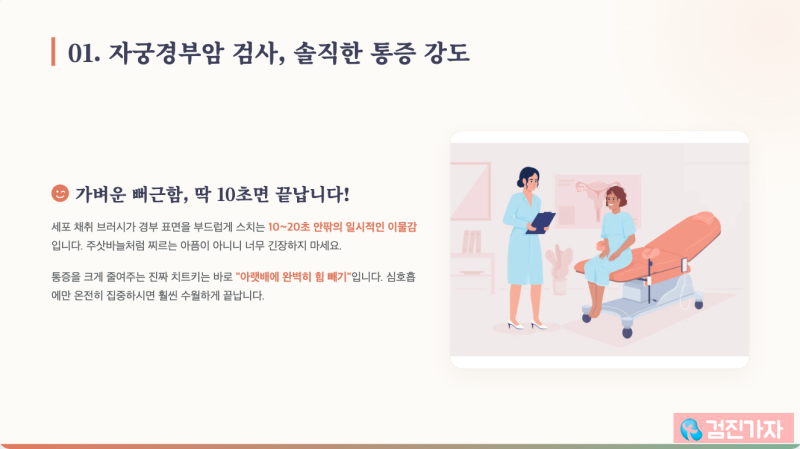
compared to how scared you might be, it is over very quickly
with just a brief stiff feeling!
The test is conducted by
gently scraping cervical cells
with a small brush.
The actual time the instrument is inserted
and the cells are collected
takes at most 10 to 20 seconds.
The most important tip for pain relief here is
to relax your lower abdomen.
If you tense up, shrink your body,
and squeeze your buttocks or lower abdomen,
you might feel significant pain or discomfort
when the instrument enters.
If you take deep breaths
and focus on relaxing your entire body,
you will find yourself saying, ‘Is it already over?’
It is my test day, but my period suddenly started! (Tips for menstruation)
This is one of the most frequent questions
many people ask us.
Can I get tested while on my period? Is it okay if my period is almost over?
The best answer is
please avoid scheduling during your period and the 2-3 days before and after.
If menstrual blood is mixed in,
the cells collected from the cervix
will be obscured by the blood,
making accurate observation under a microscope difficult.
In other words,
even if abnormal cells are present,
there could be an error
where they are not properly detected.
Therefore,
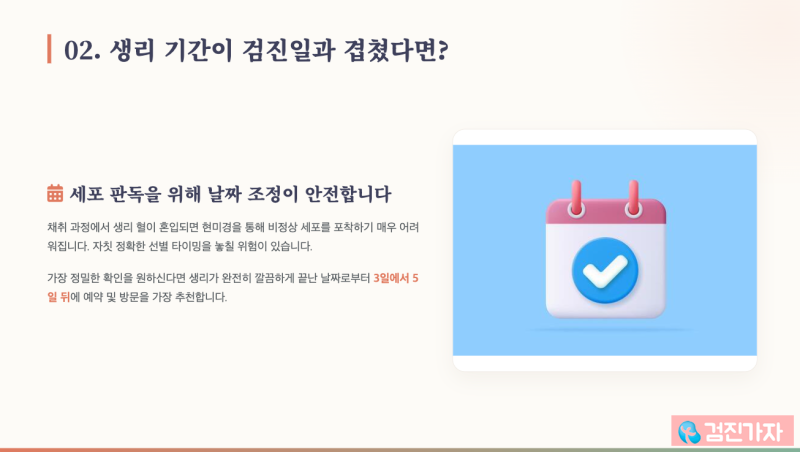
the most optimal time for an accurate test
is 3 to 5 days after your period has completely ended.
If your period starts on the day of the test,
do not panic.
Simply contact the hospital or screening center
and postpone only
your cervical cancer test schedule.
Precautions the day before for accurate test results
Minor actions before the test
can reduce the accuracy of the results.
Please remember just two things.
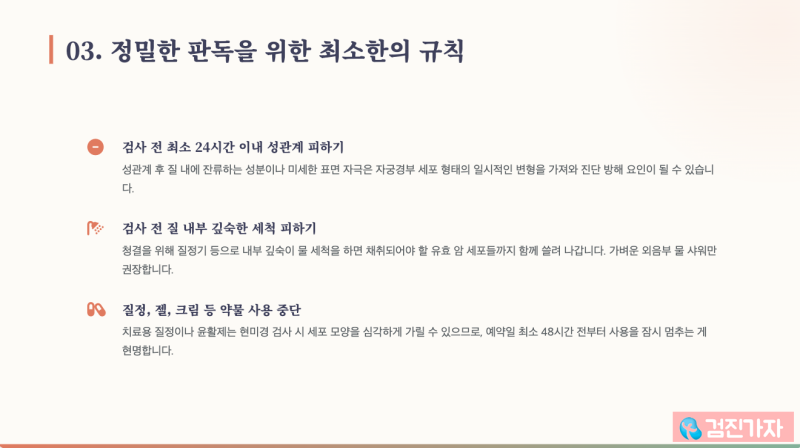
No sexual intercourse for 2-3 days before the test
Semen or external stimulation
can cause cellular changes
or interfere with an accurate reading.
No vaginal douching or use of vaginal suppositories
While we understand the desire
to wash thoroughly for hygiene before you go,
washing deep inside the vagina
(using feminine wash)
or using suppositories or creams
can wash away
the cervical cells that need to be tested
or obscure them with medication.
On the day before the test,
it is best to lightly wash
only the outside of the vulva with water when showering.
An opportunity that comes every year, do not delay and get it done easily!
Cervical cancer is the only cancer
that can be almost perfectly
prevented and treated early
through vaccines (HPV vaccination) and regular screenings.
If you are a South Korean woman aged 20 or older,
anyone can receive this benefit for free
once every two years,
so do not put it off until the end of the year
just because you are scared,
and book your appointment in advance!
To go directly to Geomjin Gaja,
click the image below.

When you want to make a complex health screening reservation
or find a screening center that is right for you,
do not hesitate
and try using Geomjin Gaja.
For your healthy and comfortable
screening day,
we will always return with useful information.
If today’s article was helpful,
please add us as a neighbor and hit the like button!
Thank you.
Frequently Asked Questions
How much pain is involved in a cervical cancer screening?
It's a very brief, dull ache that lasts no more than 10 to 20 seconds. If you tense up or strain your lower abdomen when the speculum is inserted, the pain can increase, so it's most important to take deep breaths, relax your lower abdomen, and stay calm to alleviate the pain.
Can I get a cervical cancer screening during my period?
No, it's best to schedule your appointment to avoid your menstrual period and the 2-3 days before and after it. If menstrual blood is mixed in, the collected cells can be obscured by blood, making accurate observation difficult under a microscope and potentially leading to missed abnormal cells. The best time is 3-5 days after your period has completely ended.
What should I do if my period suddenly starts on the day of my appointment?
You should contact the hospital or screening center and simply postpone your cervical cancer screening appointment. Don't panic; inform the testing facility of the situation and reschedule your appointment for 3-5 days after your period has completely ended.
What precautions should I take before a cervical cancer screening?
You should avoid sexual intercourse for 2-3 days before the test and refrain from vaginal douching and using vaginal suppositories. Semen or external irritation can cause cell changes, and deep vaginal washing or medication use can wash away cells to be tested, making accurate interpretation difficult.
Who is eligible for the National Health Screening for cervical cancer?
Any South Korean woman aged 20 or older is eligible. You can receive free screenings once every two years, so it's recommended to get regular screenings without postponing until the end of the year for cervical cancer prevention and early treatment.