2026-05-29
Can an Abdominal Ultrasound Change Your Fate? The Importance of Early Kidney Cancer Diagnosis
Kidney cancer is a silent killer with few symptoms. Learn about the risk factors, latest treatments like robotic surgery, and why early screening via ultrasound is vital for survival.
Hello,
This is Geomjin Gaja.
The organ that acts as a water purifier in our body, filtering out waste products,
is the kidney.
However,
have you ever seriously considered the fact that cancer can develop in your kidneys?
Many people often let their guard down, thinking,
‘Could there really be cancer in my kidneys?’
Patients also confess that they never even imagined it until they received a cancer diagnosis.
Let’s take a closer look at kidney cancer, which approaches silently and threatens our lives.
Why is kidney cancer called the ‘silent cancer’?
The kidneys are located deep inside the body, towards the back and below the ribs.
Because the organ is situated so deep within the body,
even if cancer occurs, it often shows no symptoms until it grows significantly in size or invades surrounding organs.
In the past,
the three major symptoms of kidney cancer were considered to be
hematuria (blood in the urine), abdominal pain, and a palpable lump in the abdomen.
However,
by the time these symptoms appeared and the patient visited a hospital,
it was often already stage 4, with the cancer having grown to over 10cm.
Fortunately, recently,
due to the activation of health checkups,
more than 70% of patients are discovering cancer at stage 1, while they are still asymptomatic.
Three Risk Factors for Kidney Cancer
While the exact mechanism of kidney cancer development is not yet fully understood,
there are clear risk factors that increase the likelihood of its occurrence.
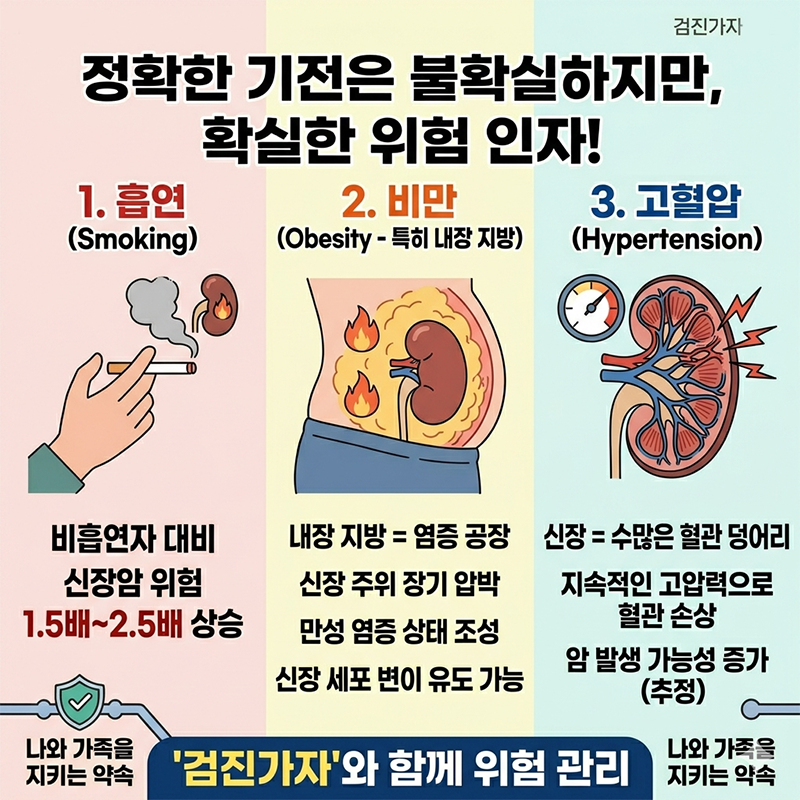
Smoking
This is the most powerful risk factor.
Smokers have a 1.5 to 2.5 times higher risk of developing kidney cancer compared to non-smokers.
Obesity
Visceral fat is a particular problem.
Visceral fat surrounds the kidneys, compressing the organs and creating a state of chronic inflammation.
Visceral fat, often called an ‘inflammation factory,’ can induce mutations in kidney cells.
High Blood Pressure
The kidney is a mass of numerous blood vessels.
It is presumed that continuous high pressure damages the blood vessels within the kidney and increases the possibility of cancer.
Latest Kidney Cancer Treatments: Save as Much of the Kidney as Possible
In the past, the entire kidney was often removed when cancer occurred,
but recently, partial nephrectomy, which preserves kidney function as much as possible, has become the standard.
Robotic Surgery
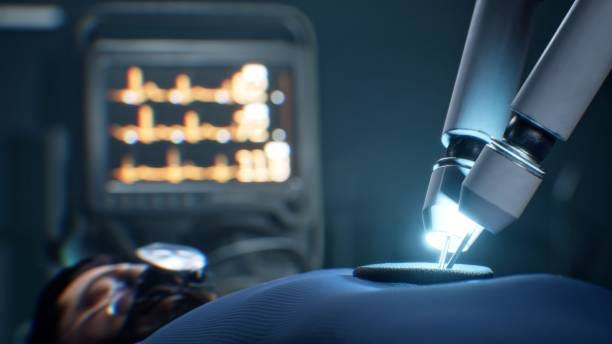
Small holes are made in the abdomen to insert robotic arms, which precisely excise only the cancerous tissue.
There is less bleeding, recovery is fast, and because the surgery is performed with a much more magnified view than the naked eye, damage to surrounding tissues can be minimized.
Cryotherapy
This is performed for patients for whom surgery is difficult or who are elderly.
A special probe is inserted into the cancer tissue, which is then frozen to -180 degrees Celsius to burst and kill the cancer cells.
Radiation Therapy (SBRT)
In cases where surgery is difficult due to chronic kidney disease, etc., high-intensity radiation can be focused only on the tumor to achieve an effect close to a complete cure.
Is it okay to have one kidney removed?
Many patients worry about decreased kidney function after surgery.
However, even if only one kidney remains in our body,
the remaining one tends to work harder than usual and recover to about 70-80% of the original function.
Especially in the case of a partial nephrectomy,
if thorough dietary control and blood pressure management are combined after surgery, health can be maintained without significant disruption to daily life.
The Key to Kidney Cancer Prevention and Early Detection
The survival rate for stage 1 kidney cancer is very high at over 90%,
but for stage 4, where it has metastasized to other organs, it drops sharply to below 20%.
Therefore,
early detection is life itself.
The methods for preventing and managing kidney cancer are clear.
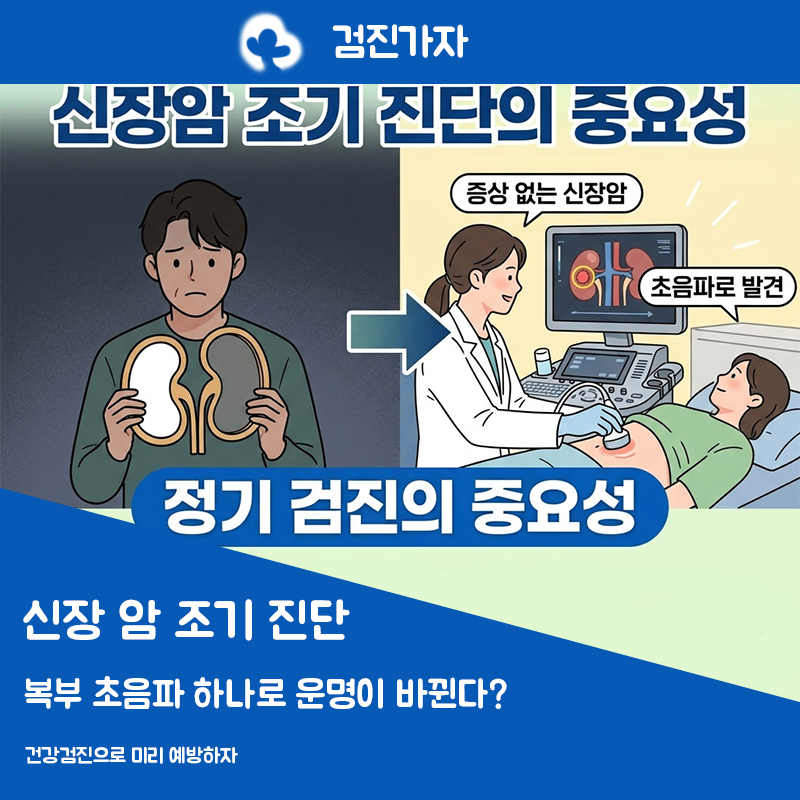
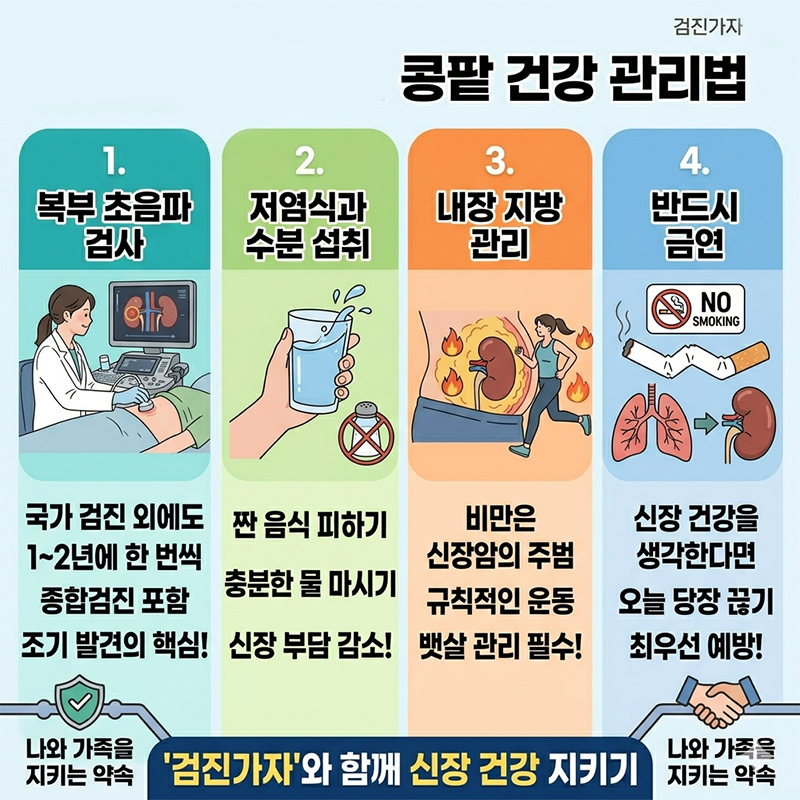
Abdominal Ultrasound
In addition to national health screenings,
it is recommended to undergo a comprehensive checkup including an abdominal ultrasound every 1 to 2 years.
A significant portion of kidney cancers can be detected early through ultrasound alone.
Low-Sodium Diet and Hydration
Avoiding salty foods and drinking enough water is the most basic way to reduce the burden on the kidneys.
Visceral Fat Management
Obesity is a major culprit of kidney cancer.
You must manage belly fat through regular exercise.
Must Quit Smoking
If you care about your kidney health, you should quit smoking immediately today.
Kidney cancer is a disease where you should not wait until symptoms appear.
The only way to find cancer cells that might be growing inside your body without you knowing is through regular health checkups.
▼ Abdominal Ultrasound Spring Health Checkup Event KMI Suwon ▼

▼ If you need to inquire about KMI Suwon reservations ▼
(Tel : 1600-2137)

▼ If you are curious about nationwide health checkup centers for the exciting Spring Comprehensive Checkup ▼

Why not check your precious kidney health right now through Geomjin Gaja?
This spring event is a great opportunity to receive customized comprehensive checkups with affordable cost benefits.
Protecting your health while you are still healthy is the wisest choice.
#KidneyCancer #RenalCancer #KidneyCancerSymptoms
#KidneyCancerCauses #KidneyCancerTreatment #HealthCheckup
#AbdominalUltrasound #KidneyCancerSurgery #RoboticSurgery
#PartialNephrectomy #ObesityAndCancer #SmokingRisks
#BloodPressureManagement #VisceralFat #CancerPrevention
#EarlyScreening #HealthManagement #GeomjinGaja #ComprehensiveHealthCheckup
Frequently Asked Questions
Are there no early symptoms of kidney cancer?
No, there are almost no symptoms in the early stages. The kidneys are located deep within the body, so it is often asymptomatic until the cancer grows quite large or invades surrounding organs. In the past, many cases were diagnosed as stage 4 after patients visited the hospital due to hematuria or abdominal pain.
What are the main risk factors for kidney cancer?
Smoking, obesity, and high blood pressure are typical risk factors. Smokers, in particular, have up to 2.5 times higher risk of developing the disease than non-smokers, and visceral fat can compress the kidneys and cause inflammation, promoting cancer cell mutations.
Do I have to remove the entire kidney during kidney cancer surgery?
No. Recently, partial nephrectomy, which preserves kidney function as much as possible, is the mainstream. Robot-assisted surgery is mainly used to precisely remove only the cancerous tissue, minimizing bleeding and damage to surrounding tissues and aiding recovery.
Is treatment possible for elderly patients or those for whom surgery is difficult?
Yes, it is possible. For patients for whom surgery is difficult, cryotherapy, which freezes and kills cancer cells with a special probe, or radiation therapy, which intensively irradiates only the tumor with high-intensity radiation, can be performed to expect effects close to a complete cure.
What tests are needed to detect kidney cancer early?
Abdominal ultrasound is the most effective test. If you undergo a comprehensive health check-up, including an abdominal ultrasound, once every 1-2 years, a significant number of kidney cancers can be detected early, even in stage 1 when there are no symptoms.