2026-05-29
How to Verify the Safety of Your Child's School Meals and Convenience Store Food
Learn about Korea's food safety systems, including HACCP and imported food inspections, to ensure the safety of school meals and convenience store products.

Hello,
This is Geomjin Gaja.
With the recent rise in single-person households,
the number of ‘convenience store enthusiasts’
who enjoy quick meals is increasing,
and parents' concerns regarding
the hygiene of school meals
are also deepening.
Have you ever wondered how safely
the food we encounter every day—
especially affordable imported foods
and convenience meals—is being managed?
Let’s take an in-depth look at
HACCP and the imported food management system,
which are the core of South Korea’s food safety system.

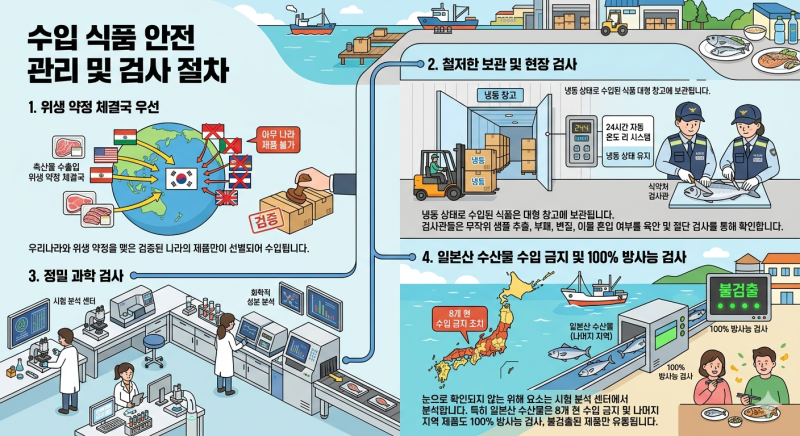
How is the quarantine of imported food on our tables conducted?
Due to climate change and declining fish catches,
finding imported seafood and agricultural products
on our dining tables is no longer a rare sight.
While many people worry about
chemical treatments or preservatives in imported food,
they actually enter the country through
a very rigorous process.
Priority for Countries with Hygiene Agreements
Products cannot enter from just any country.
Only products from verified countries
that have signed livestock product import/export
hygiene agreements with South Korea
are selected for import.
Thorough Storage and On-site Inspection
Imported frozen foods are stored in
large warehouses equipped with
24-hour automatic temperature control systems.
Ministry of Food and Drug Safety (MFDS) inspectors
randomly extract samples to check for spoilage, deterioration,
and foreign substances through visual inspection
as well as cutting tests.
Precision Scientific Testing
Hazards that cannot be seen by the eye
are sent to test and analysis centers
for microbial and chemical component analysis.
In the case of Japanese seafood specifically,
along with the import ban on 8 prefectures,
products from the remaining regions undergo 100%
radiation testing, and only those with
zero detection are distributed.
What is HACCP, the Magic Word for Food Safety?
When buying convenience store lunch boxes, kimchi, or fish cakes,
the HACCP mark often seen on the back
is the symbol of safety.
HACCP (Hazard Analysis and Critical Control Points)
is a preventive system that blocks
potential hazards at each stage,
from raw material production
to consumption by the final consumer.
Expansion of Mandatory Application
Currently, manufacturing companies with
annual sales of 10 billion KRW or more
are required to obtain HACCP certification,
and this requirement is gradually expanding.
Transparency in the Manufacturing Process
HACCP-certified factories strictly manage
every process, from testing raw materials for food poisoning bacteria
to checking employee hygiene, equipment cleanliness,
and removing foreign substances using metal detectors.

Smarter Food Information and Enforcement Systems
To guarantee the consumer’s right to know,
food labeling standards are being strengthened.
Starting next year, the tiny font size
on ingredient lists will increase to 10 points,
and key information such as calories and sugars
will be placed on the front
so that anyone can easily check them.
Additionally,
to root out unscrupulous businesses
that forge expiration dates or manufacture
substandard food, a ‘One-Strike Out’ system
is in effect.
This is a powerful measure where a single
serious violation can lead to the closure of the business.
The MFDS also uses a real-time hazardous
food sales blocking system to ensure that
products judged unfit cannot be
automatically processed at mart checkout counters.
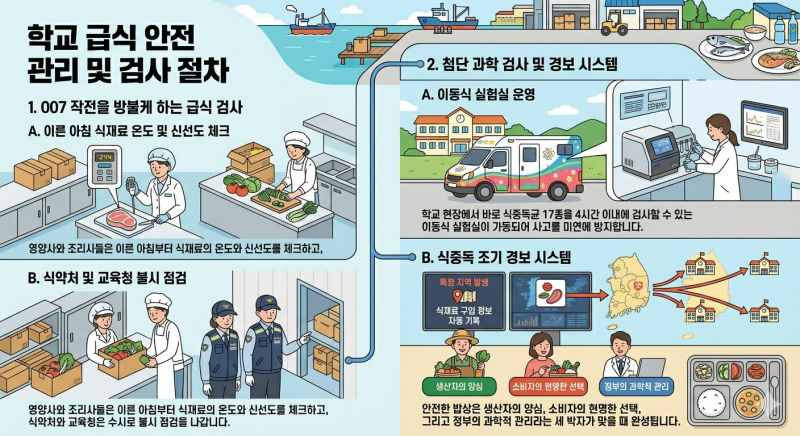
Managing School Meals to Protect Children's Health
Inspections for children's school meals
are conducted with the intensity of a ‘007 mission.’
Nutritionists and cooks check the temperature
and freshness of ingredients from early morning,
and the MFDS and Offices of Education
conduct frequent unannounced inspections.
Operation of Mobile Laboratories
Mobile laboratories capable of testing for
17 types of food poisoning bacteria within 4 hours
operate directly at school sites
to prevent accidents in advance.
Early Warning System for Food Poisoning
Ingredient purchase information is automatically recorded,
so if food poisoning occurs in a specific region,
an immediate alert is issued to all schools
using the same ingredients.
A safe dining table is completed when three elements align:
the producer's conscience, the consumer's wise choice, and
the government's scientific management.
When purchasing food,
the small habit of checking the HACCP mark
and the detailed ingredient list
is the first step in protecting your family's health.
This has been Geomjin Gaja.
#GeomjinGaja #HACCP #FoodSafety #MFDS #ConvenienceStoreFood #SchoolMeals #FoodPoisoningPrevention #ImportedFood #FoodSanitationAct #RadiationTesting #ExpirationDate #SafeFood #DietaryManagement #Hygiene
Frequently Asked Questions
What inspection process do imported foods go through before distribution?
Yes, they undergo a very strict quarantine process. Only products from countries with hygiene agreements are imported, and they undergo 24-hour temperature control as well as visual and cutting inspections through random sampling. After that, they must pass precise scientific examinations that analyze microbial and chemical components before they can be distributed.
How are radiation inspections conducted for seafood from Japan?
100% radiation inspection is carried out, and only products that show no detection are distributed. Currently, seafood from 8 prefectures in Japan is completely banned from import, and products from other regions also undergo thorough radiation inspection to confirm their safety.
What is the HACCP mark often seen on convenience store food?
It is a safety mark that stands for Hazard Analysis and Critical Control Points. It is a preventive system that prevents hazards that may occur from the production of food raw materials until consumption by the consumer, and manufacturers with annual sales of 10 billion won or more are obligated to obtain this certification.
How is food poisoning prevention managed in school meals?
It is thoroughly managed through mobile laboratories and an early warning system. 17 types of food poisoning bacteria can be tested on-site within 4 hours, and if food poisoning occurs in a specific area, an immediate alert is issued to all schools using the same ingredients to prevent accidents.
Is there a risk of buying defective food that has been deemed unsuitable at the supermarket?
No, it is safe thanks to the real-time hazardous food sales blocking system. Products deemed unsuitable by the Ministry of Food and Drug Safety are automatically blocked from payment when their barcode is scanned at the supermarket checkout, preventing consumers from accidentally purchasing them.