2026-05-29
Lower Abdominal Pain and Heavy Lumps: Hernia Types, Symptoms, and Prevention
Learn about hernia types, symptoms, and why early treatment is critical to prevent complications like organ necrosis and sepsis.
Hello,
This is Geomjin Gaja.
It has been quite hot lately, so the news of rain to cool things down is very welcome.
I have been really enjoying that earthy scent that only comes when it rains.
Many people, when they feel a bulging lump in their lower abdomen, navel, or groin area, often dismiss it as simple ‘flesh’ (visceral fat) or a temporary boil and leave it untreated.
However, this could be a warning sign of a hernia, a condition where an organ in our body slips out of its proper place.
I recently learned that a hernia is not just a simple discomfort; if left untreated, it is a serious condition that can lead to fatal consequences such as sepsis and organ necrosis.
What is a Hernia?
A hernia is a condition where an organ protrudes through a hole created by the weakening of the body’s supporting structures, such as the abdominal wall, navel, or inguinal (groin) area.
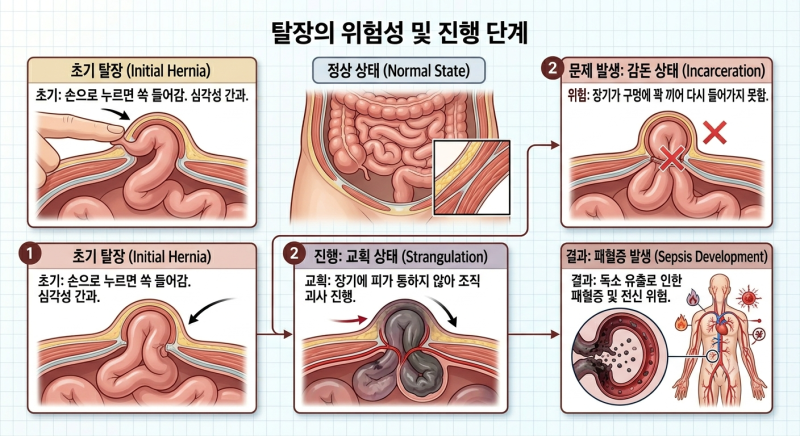
In the early stages, it often goes back in when lying down or when pushed with a hand, so many people fail to realize the seriousness.
The problem arises when an ‘incarcerated’ state occurs, where the organ becomes stuck in the hole and cannot return.
If incarceration persists, blood flow to the organ is cut off, leading to ‘strangulation,’ where the tissue begins to rot.
In this case, not only must the organ be resected, but as it rots, toxins can spread throughout the body, leading to sepsis, which can be life-threatening.
Types of Hernias and Key Symptoms
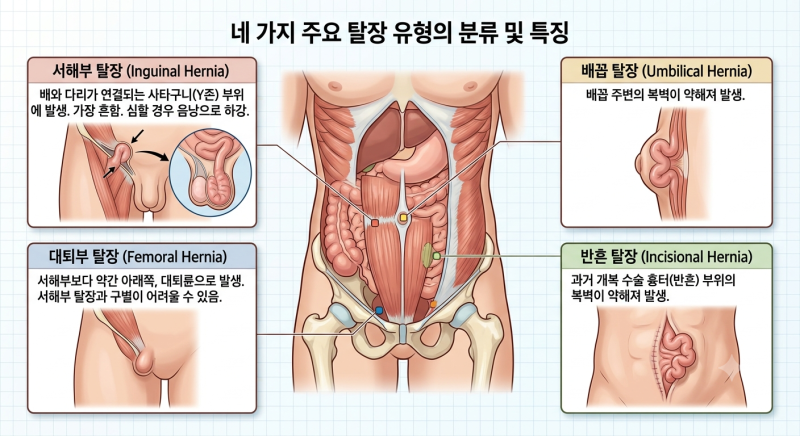
Hernias are largely classified into four types based on their location and cause.
Inguinal Hernia
The most common form, occurring in the groin (Y-zone) where the abdomen and legs meet. In severe cases, the organ may descend into the scrotum.
Umbilical Hernia (Navel Hernia)
Occurs when the abdominal wall around the navel weakens.
Femoral Hernia
Occurs slightly below the inguinal area; it can be difficult to distinguish from an inguinal hernia with the naked eye.
Incisional Hernia
Occurs when an organ pushes through a weakened scar site from a previous open abdominal surgery.
Why is it more common in men?
According to statistics, there are about 3 to 4 times more male hernia patients than female patients (accounting for 70–80% of all patients).
This is due to structural differences in the body. Women have a relatively wider pelvic structure than men to accommodate pregnancy and childbirth.

Because of this, the phenomenon where the load and pressure inside the abdomen due to gravity are concentrated on a specific area is less common compared to men, resulting in a much higher frequency in males.
Additionally, activities that rapidly increase abdominal pressure, such as excessive weightlifting or lifting heavy objects, can trigger a hernia along with sudden lower abdominal pain.
Modern Standard Treatment: Laparoscopy and Mesh Surgery
Since a hernia is a structural hole, it cannot be treated with medication and requires surgical correction.
In the past, only the torn area was sutured, but in adults, other weak spots often exist around the hernia hole, leading to a high risk of recurrence.
Recently, Totally Extraperitoneal (TEP) laparoscopic hernia repair has become the standard treatment.
A major advantage of this surgery is that the surgeon can use the laparoscopic camera to simultaneously check for and treat a hernia on the opposite abdominal wall that the patient may not have even noticed.
During surgery, a special structure called ‘Mesh’ is used to widely cover and reinforce four vulnerable areas, including the hernia hole.
Thanks to this mesh surgery, the previously high recurrence rate for hernias has dropped sharply to less than 1%.
Danger Signs You Must Not Ignore
Specialists advise that if you experience persistent, unexplained heavy pain in the lower abdomen or groin, or if you have a lump that appears and disappears, you should visit a hospital without delay.

In particular, symptoms such as abdominal pain accompanied by a disrupted lifestyle, decreased food intake, and unexplained weight loss are very dangerous warning signs from the body. You must not miss the ‘golden time’ and should receive a detailed examination immediately.
Health Checkups
▼ For reservation inquiries ▼
(Tel: 1600-2137)

#Hernia #HerniaSymptoms #InguinalHernia
#GroinPain #HerniaSurgery #LaparoscopicSurgery
#MeshSurgery #LowerAbdominalPain
#UmbilicalHernia #TEPSurgery #OrganNecrosis
#Sepsis #Incarceration #Strangulation #MaleHernia
#AbdominalWallHernia #FitnessSideEffects #AbdominalPressure
#YZonePain #HealthCheckup #GeomjinGaja
Frequently Asked Questions
Can hernias be treated with medication?
No, hernias cannot be treated with medication. A hernia is a condition where there is a hole in the body's structure, so surgical correction is absolutely necessary. Recently, surgery using laparoscopy and a mesh to cover and reinforce the weak area has become the standard treatment, which can reduce the recurrence rate to less than 1%.
What happens if a hernia is left untreated?
If left untreated, a hernia can progress to incarceration and strangulation, where organs get trapped in the hole and lose blood supply. If this condition persists, the organ may rot and need to be resected, and it can also lead to sepsis, where toxins spread throughout the body, threatening life. Therefore, early treatment is very important.
Why are hernias more common in men?
This is due to structural differences in the male body. Women have wider pelvises for pregnancy and childbirth, which disperses abdominal pressure, while men's narrower structure makes it easier for weight and pressure to concentrate in specific areas. Additionally, activities that increase abdominal pressure, such as lifting heavy objects, are also major causes.
What are the main suspicious symptoms of a hernia?
The typical symptoms include a bulging lump in the lower abdomen or groin area, or a dull, heavy pain. In the early stages, the lump may recede when lying down, but if it is accompanied by abdominal pain, reduced food intake, and weight loss, it is a very dangerous sign and requires immediate detailed examination at a hospital.
Is there no risk of recurrence after hernia surgery?
No, with recent surgical methods, the recurrence rate is very low, less than 1%. In the past, only the torn area was sutured, which carried a high risk of recurrence. However, currently, the condition is checked with a laparoscopic camera, and the surrounding weak areas are widely covered and reinforced with a mesh, effectively preventing recurrence.